

Seeing Inside Concrete: How Ferro scanning supported a practical 6-metre retaining wall upgrade
Updated: Feb 11
When working with existing structures, one of the biggest engineering challenges is understanding what’s already there, especially when original drawings are incomplete, outdated, or unreliable. Ferro scanning gives engineers detailed information on existing concrete structures and reinforcement through a non-invasive method, allowing them to make informed, practical decisions.
On a recent 6-metre-high retaining wall strengthening project, we used Ferro scanning to map existing reinforcement, verify structural assumptions, and support a practical, consent-ready strengthening solution. The scan data were interpreted in accordance with NZS 3101:2006 (Concrete Structures Standard) and AS/NZS 4671:2019 (Steel for Reinforcement), ensuring that all assessments aligned with New Zealand’s structural design requirements.


What is Ferro Scanning?
Ferro scanning (also known as rebar scanning) is a non-destructive testing method used to locate and assess reinforcement embedded within concrete elements.
Using specialised equipment, such as the Hilti PS 1000 X-Scan Concrete Scanner, engineers can identify:
Reinforcement location and spacing
Approximate bar diameters
Depth of reinforcement cover
Variations in wall thickness
Voids and inclusions
This allows engineers to “see inside” concrete elements without cutting, coring extensively, or causing damage to the structure.


Concrete Scanning
What Does Ferro Scanning Help Achieve?
Ferro scanning is particularly valuable for existing buildings and infrastructure, where understanding actual construction is critical. It helps to:
Reduce uncertainty when drawings are missing or inconsistent
Confirm reinforcement layouts before designing strengthening works
Support building consent documentation with site-verified data
Avoid over-conservative design, saving time and cost
Minimise intrusive investigation, especially in residential areas
In short, Ferro scanning bridges the gap between assumptions and reality, leading to safer, more efficient engineering outcomes.


Project Overview: Understanding and Strengthening an Existing Retaining Wall
This project involved the assessment and strengthening design of a large existing concrete retaining wall supporting a residential backyard. With a height of approximately 6 metres and a length of around 13 metres, the wall plays a critical role in maintaining ground stability and protecting the dwelling above.
Over time, the retaining wall began to show clear signs of structural distress, including:
outward leaning
separation and detachment
progressive deterioration over time
Given the size of the wall and the level of ground it supports, these issues raised legitimate concerns about its long-term performance and safety.
For homeowners, problems of this scale can be confronting, particularly when visible movement suggests that a retaining wall may no longer be performing as intended.
For engineers, the challenge lies in understanding how the wall was originally constructed and whether its existing capacity is sufficient under current conditions and design standards.
DTCE was engaged to prepare building consent documentation for the strengthening of the retaining wall. By combining site observations with Ferro and Lidar scanning, the project team was able to gain a clear understanding of the wall’s internal reinforcement and overall condition, forming the basis for a practical strengthening solution.


Site Visit and Ferro Scanning Investigation
DTCE carried out a site visit to locate and assess the existing reinforcement within the retaining wall prior to finalising design assumptions. Using the Hilti PS 1000 X‑Scan Concrete Scanner, the team conducted several tests across the wall to map the location and size of reinforcement. The scans revealed that the wall contained a single layer of reinforcement, with some variations in bar placement and minor cracks observed in parts of the structure. Bore core samples from the soil anchor’s installation confirmed the general findings of the scan.
By combining Ferro scan results, visual inspection, and Lidar scans, DTCE was able to verify structural assumptions and evaluate the current compliance level of the retaining wall against the New Zealand Building Code. The insights gained from this non-invasive method allowed the team to finalise a strengthening solution without unnecessary demolition or intrusive testing.
The main front existing wall (Two Test Locations)


The side existing wall (Third Test Location)


Strengthening Approach: Soil Anchors
The proposed solution incorporated soil anchors to strengthen the front face of the retaining wall.
These anchors are embedded into the underlying rock layer at a specified length to provide additional resistance against overturning and movement. The anchor geometry and layout were designed specifically to suit the existing wall configuration and site constraints.

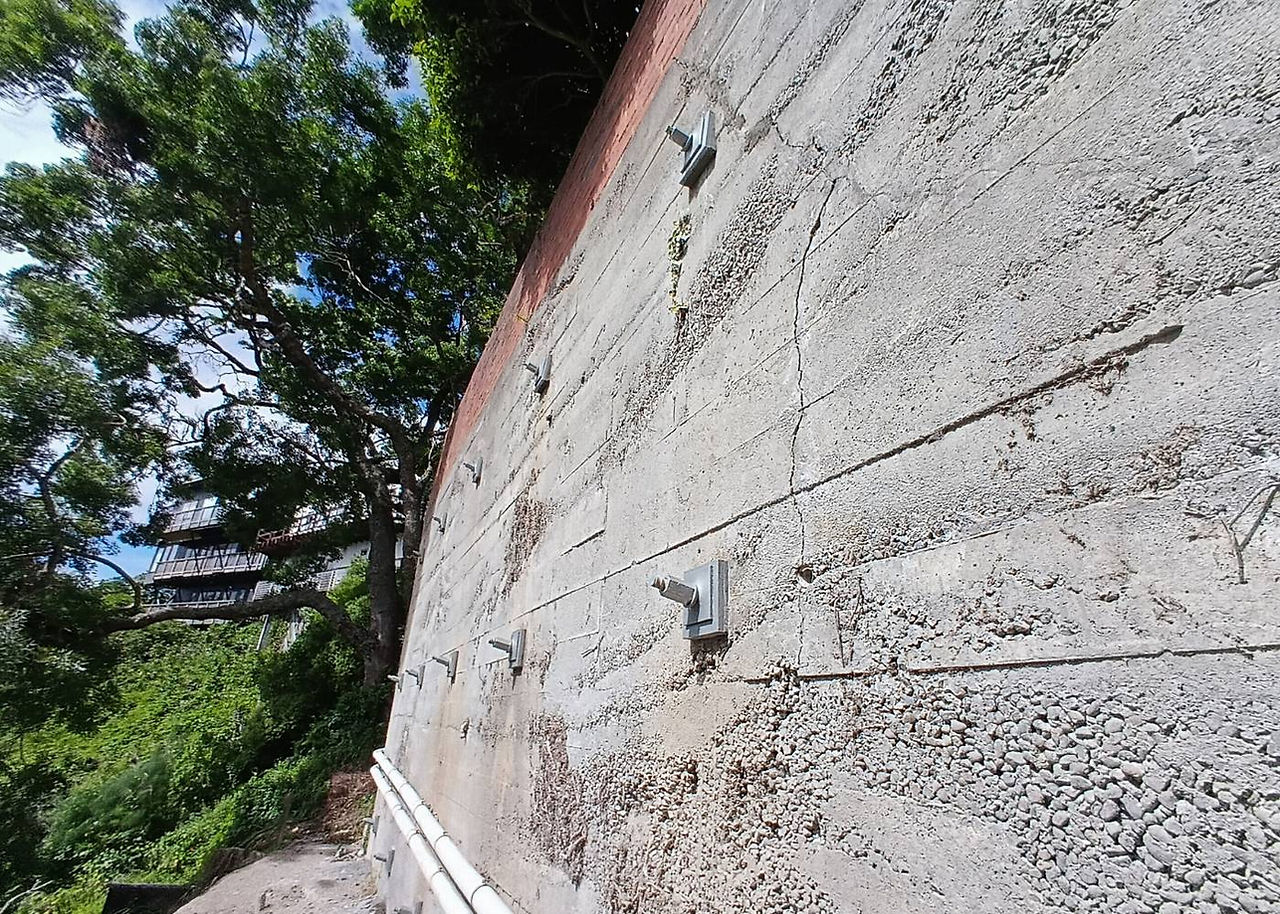
Designed
Built
Conclusion
The purpose of the works is to strengthen the retaining wall in a practical, robust manner.
Ferro scanning confirmed the presence of reinforcement and allowed DTCE to assess both conservative and likely scenarios. Importantly, the results did not change the proposed strengthening solution. The scanning outcomes provided confidence and transparency, supporting informed decision-making for all parties involved.
How DTCE Uses Ferro Scanning
At DTCE, Ferro scanning is used as part of a balanced, evidence-based approach to existing structure assessments. It allows us to:
Validate assumptions
Reduce unnecessary conservatism
Support clear, defensible engineering decisions
Provide councils and clients with confidence in the design approach
Used alongside site observations, historical information, and engineering judgement, Ferro scanning helps ensure strengthening solutions are fit-for-purpose, buildable, and consent-ready.
Planning Strengthening or Retrofit Work? Let’s Start with What’s Inside
Every project presents its own set of challenges, but when engineers understand “what’s inside,” they can make better decisions for safety, performance, and long-term resilience.
If you have some challenging projects or would like to know more about how Ferro Scanning or 3D LiDAR scanning can support your building or strengthening work, please don’t hesitate to reach out to us.
Call DTCE Consulting Engineers at 04 475 7933 or fill out our contact form by following the link below.
FAQ
How long do retaining walls last?
Retaining walls can last anywhere from 20 to 100 years, depending on the material used and maintenance. Properly constructed stone or concrete walls tend to have the longest lifespan.
When to replace a retaining wall?
Replace a retaining wall when signs of significant damage appear, such as large cracks, bulging, or leaning, which indicate structural failure.
Who is responsible for a retaining wall?
The responsibility usually lies with the property owner where the retaining wall is located, but this can vary depending on local regulations or specific property agreements. Many retaining walls on boundaries have a shared responsibility between properties on either side of the boundary, and the responsibility can also be based on who benefits the most from the retaining wall.
Why do retaining walls fall?
Retaining walls can fail due to inadequate design, poor construction, lack of drainage, natural wear and deterioration over time, or an unplanned external influence like excessive rainfall, earthquakes, or even tree roots.
Can retaining walls be repaired?
Yes, repairs are possible for some issues, but significant damage might require partial or complete reconstruction.
How to choose the right structural engineer in Wellington?
When choosing a structural engineer in Wellington, look for a team with strong local experience and a clear understanding of Wellington’s seismic risks, wind conditions, and ground behaviour. Check that the engineer is Chartered (CPEng), has a proven track record with similar projects, and is familiar with local council consent processes.
It’s also worth considering how they communicate, good structural engineers don’t just design solutions; they explain risks, options, and costs clearly so you can make informed decisions. Local knowledge, transparent advice, and experience with complex or constrained sites can make a significant difference to both project outcomes and timelines.
Soil testing and engineering
Soil testing in engineering evaluates soil characteristics, crucial for designing foundations and ensuring different soil tests include moisture content, compaction, bearing capacity, and permeability tests, each providing data on soil behavior and properties.


Comments